
Kamal Haasan Completes 67 Years In Cinema: I Can Only Salvage About 20 Years As My Actual Learning
Kamal Haasan has spent nearly seven decades navigating the constantly shifting landscape of Indian cinema. Yet, even after 67 years in the industry, the actor does not seem particularly interested in looking back at his career as a finished achievement. Instead, he appears more fascinated by what remains to be learnt.
On Thursday, Kamal took to social media to thank audiences who marked the milestone with him, while offering an unusually self-critical assessment of his journey. “Thanks to all who wished me well on my 67 years of cinema. Out of those 67, I think I can only salvage about 20 years as my actual learning. The rest was going with the flow of the wastewater,” he wrote.
The metaphor continued as Kamal reflected on the unpredictable nature of a life spent making films. “The uplifting hope is, however dark the waterway turns out to be, the wait for a confluence with the largest singular form called the collective cinema, an unchannelled sea. We are all flowing towards it – artists, audience, and all. So I guess what I have salvaged as experience can be improved upon before people stop counting my years in this field and start looking for better numbers elsewhere.”
There is something revealing about the way Kamal views longevity. For an actor whose career is often discussed in terms of records, landmark performances and reinvention, he seems less interested in the number itself than in the lessons buried within it.
From child artiste to cinema’s eternal student
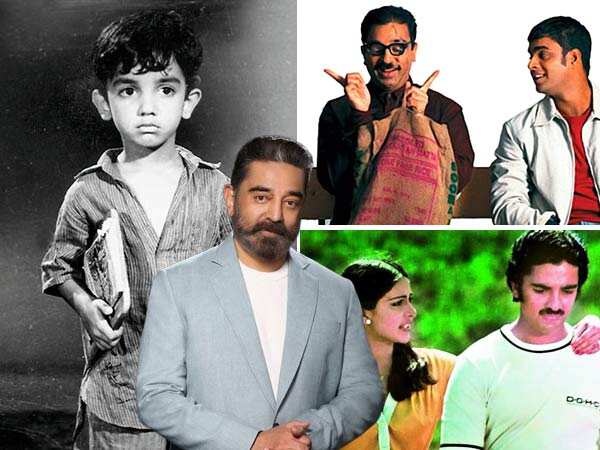
Kamal’s association with cinema began when he was barely six. His debut in A Bhimsingh’s Kalathur Kannamma in 1960 introduced audiences to a child performer who would go on to become one of Indian cinema’s most adventurous actors. His performance earned him the President’s Gold Medal, setting an extraordinary precedent for a career that would eventually encompass acting, filmmaking, writing, production and choreography.
More than six decades later, Kamal placed his own journey within the much larger history of the medium itself. Pointing out that the Lumière brothers’ first public screening took place in December 1895, he noted that cinema has existed for approximately 130 years and eight months. He then reflected on the fact that his own career accounts for more than half of that period.
“Since the Lumière brothers’ first public film screening in December 1895, the film industry has been around for approximately 130 years and 8 months. My team reminded me that I have been around for 67 of those years, more than half of the entire history of the film industry! That is a rather extraordinary thought to take in. Yet, in my own account, I can claim only about 20 years as actual learning,” he added.
The observation is particularly striking coming from an actor whose career has been defined by experimentation. From his early years as a child artiste to films such as Moondram Pirai, Nayakan, Indian and countless other collaborations across languages and genres, Kamal has repeatedly treated cinema as a craft to be interrogated rather than merely practised.

Still looking ahead after 67 years
That attitude remains evident in the projects surrounding him today. Kamal was last seen in Mani Ratnam’s Thug Life in 2025. His upcoming slate includes his collaboration with stunt duo-turned-directors Anbariv, while his much-anticipated on-screen reunion with Rajinikanth, directed by Nelson Dilipkumar, is also in development.
For someone who has witnessed cinema transform from celluloid to digital filmmaking and now into an era of virtual production and artificial intelligence, perhaps the most Kamal Haasan thing about the milestone is that he refuses to treat it as an endpoint. He ended his note with a line that neatly captures that restless curiosity: he described himself as “probably the oldest of the Gen Z.”
After 67 years, Kamal Haasan’s greatest claim may not be that he has survived cinema’s changing tides. It is that he still wants to learn how to swim.
Also Read: Kamal Haasan Hails Christopher Nolan’s The Odyssey